Sunday, October 30, 2016

CQWW SSB 2016 SOAB HP - VU2XE

It is that time of the year when Hams around the globe warmup and charge ionosphere to create their own Propagation Conditions. And this is Year 2016 with downward Solar trend. Let us enjoy every bit which is there to offer by Sun god!


Preparations:

Often it is told that test results are only as good as its preparation. And such preparations can run for years together and certainly in my case it was. 
Few major things i had aimed for last year were:
2. Better Antenna
3. Decent amplifier

I am fortunate enough to accomplish these key goals for my hobby this year starting first with my call sign from VU3KPL to VU2XE as general (advanced) license grade, then upgrade Hexbeam to Spiderbeam and finally getting W6PQL amplifier project working. Here is my journey for you to enjoy!


License upgrade:

As soon as i decided to upgrade my station last year around August (probably pondering over it for couple of years), other than taking upgrade exams, I started researching about amplifiers. Though i reside in Bangalore, my affection towards my hometown Mangalore and its friendly people drove me to take exams from the same monitoring station that took my first license exam during year 1995-97. With great help of ham friends, i appeared for the exam and completed first hurdle required in last week of October 2015. Thanks to VU2MTT, VU2NXM and lot others who helped me with preparation of the exams, which not only included 12WPM CW, but recently some advanced topics in rules. Numerous followups to WPC wing at Delhi resulted in upgrade granted by mid of this year. I must say VU2XE was not my choice. I had requested them to provide 2 letter callsigns because of my contest interests. Though two letter request was honored, my choice of letters were not. I am getting used to it and it sounds nice.. hi hi!


Amplifier:

Around the same time, I got to know about W6PQL (Jim) amplifier kit. Though there were less expensive options were available, i took this project because of exhaustive information shared by Jim and upcoming popularity of LDMOS. It not only was expected to put me on air with HP category but also help me to refresh my EE skills and put that in practice. I must admit that it was real journey since then. Building each bit of the project such as sourcing components, putting together home lab for assembling and testing itself became year long fun activity. It was more than melting solder to parts and screwing things down. At each stage, understanding RF concepts and testing them for perfection became addiction along the way. And that means, building/buying testing equipments as well. In VU, our legal power for advanced or general grade is 400W and this amplifier could deliver three times of that power. Working carefully with continuous remote guidance became vital aspect. Thanks to Jim, who responded almost as if he is in VU time zone most of the time!. 


Me working at apartment balcony converted as lab ?!
Mouser and element14 became regularly visited for quality components along with local S.P road electronic shops in Bangalore. Project's enclosure came from a lab equipment enclosure dealer in Mumbai who supplied extruded aluminum chassis. Later learnt that similar 3U/4U type of chassis could have been bought at local computer supply dealers. Jim had also mentioned 2D design of front and back plates of the amplifier. In absence of online laser cut firms such as Front Panel Express mentioned by Jim, I had to design my own version of the plates and get it cut at local laser cutting shop. For me, I live just next to Bangalore's biggest Industrial estate- Peenya. Where world class electronic and mechanical industries have their shops. 


Clockwise - Kevin W9CF, Lee KY7M, Andy NY7N, Bob K8IA, 
Kiran VU3KPL, Mike KC7V, Ned AA7A, Gary N7IR
Again nothing is cheap when it comes to quality. In Feb/March 16, I got opportunity to visit Arizona, USA for my morning QTH activity. I happened to chat with Jim on phone. What a pleasure talking to him. Hams around the world share common spirit of designing, building and having fun on air. During the same time, I got acquainted with K8IA Bob and Arizona Outlaws Contest Club. A fine group of Contesters, DXers and DXpeditioners such as this is inspiration for any ham. It gave me my first hand walk-in experience to multi-two contest site of theirs at Bob's residence near Phoenix AZ during a contest.


LDMOS Amplifier ready for integrated testing!
Returning back to home country, a lot of solder flow and drill work later, finally during September 16, the amplifier got into the enclosure box. And by now it was time to perform smoke test without causing smoke out of any parts hi hi!. Fortunately all worked, except for readings on Forward and reverse LED graphs. This may be cause of first time RF assembler mistake such as wiring in the enclosure etc. However, this troubleshooting continues as we go here..

Just a week before the contest, I had tripped my SMPS 800RE (800W DC SMPS supply from Connex Electronics) without understanding RFI issues and damaged it. Panic stuck me ordered used ESP120 ( HP Blade server''s PSU) locally and this time I placed toroids at input DC power lines just in case issues continued. This beast supply (OEM spec'ed at whopping 2930Watts!) has personality of its own with booming fan sound in the background and not even a drop in voltage providing adequate juice required for CQWW without a blink! 


This amplifier setup played awesome role in my 15m and 10m run this time pushing VU legal limits without any hiccups. Though 20m had problems due to higher SWR which on second day i resolved using loaned MFJ tuner limited to 200W out.


Boy.... being first time beyond 50W level, it is surely a adrenaline rush when stations lineup for you!

Just joy to say Five Nine TwoTwo :)./ with your own handmade amp talking hi hi..

Antenna and Propagation:

Spiderbeam around 15ft above my Apartment terrace (140ft)
In April-May this year, i took down my homebrewed Hexbeam and cut its spreaders for shaping it as Spiderbeam. Within a week, early Monsoon rain and winds fractured its spreaders. The spreaders i used were local and holding good for my Hexbeam earlier due to its mechanical structure. However with Spider, wing span takes special attention for sure. Ordered Spiderbeam spreaders from Germany and finally new structure was made ready when still a month to go for CQWW. This definitely adds 2Db over my hex (is it 1/2 S Unit?)

Antenna proved its goodness for sure with lot of JAs in our local mornings worked and EUs in the rest of the time.


Propagation stayed erratic. With major storm passing (Flux 79, A 26 and K 4), it was not expected to be great contest time. There was no hope on higher bands, but then 20m also closed just while after 10PM local (16:30 UTC). 40 and 80 would have been the good bands, however, i had recently downed my OCF dipole for LMR cable to connector issues. No sweat there, probably it is due for CQWW CW. 


Summary:

For me, these contests  are a big inspiration and drivers to improvise the station and my knowledge. I scored 600+ Qs for the first time on SSB and definitely it is not near to any VU HP marks. However, I earned a lot of knowledge in the process of working them. All these years I stayed below 50W level and worked the world and had admiration for those big guns with sensitive ears. Now I started developing even further respect to their work on preparations.

There were not many wow moments this time working Caribbean and South America  from here. Each QSO out of my brewed amp was a like a Diwali gift to me :). One YO station greeted me "Namaste, Happy Diwali Kiran! you are 59 ..". Thank you dear - truly, it is our largest festival time here in India and I enjoyed every bit of this contest while overlooking Fireworks from my apartment window at night!. 

Couple of QSOorder recordings are embedded here for your interest. Check how my station hears you! 

Clipping from one of the best EU run i had 128 Q/hr with 300-350W on 21Mhz. Though lived short, it really made me happy!


Listen to following snip from K3LR QSO. He picks me up in clear one shot! No wonder 250 watts works better on 20m than 50W i used to earlier. These big gun stations are beacons for us over the pole :) 


Here is finally score from N1MM software:
 Band     QSOs     Pts  ZN   Cty  Pt/Q
    14     143     400   16   43   2.8
    21     371     970   21   76   2.6
    28      92     168   10   25   1.8
 Total     606    1538   47  144   2.5

Score: 2,93,758

Looking forward for CQWW CW in November!
Cheers

Kiran

Update 7th Nov 2016: Just an update on the LED BarGraph reading related issue. It got resolved on 6th Nov finally. I will write a short blogpost soon on this troubleshooting exercise and with Arduino sketch of the project etc.

Friday, October 21, 2016

Antenna Switches

Hams are experimenters by nature. It is proven fact that if there is an investment to be made in the station, antenna should be considered first. This is because transmission signal quality in a given direction is well tied to the antenna. As soon as we go for multiple antennas on our roof, need for multiple transmission lines becomes a need. Often this is found to be cumbersome to lay multiple coaxes. Antenna switch is a simple device which can be placed near to antenna system with a single coax and a control line running to it. Although it is simple switching device, poor quality of relays, boards and even the enclosures can yield to losses or even interference. 

Following are the key considerations when homebrewing or buying an antenna switch:
  1. Number of antenna ports
  2. Insertion loss
  3. Port Isolation
  4. weather and EMI proofing
  5. Mounting mechanism
  6. Control device
  7. Control line
Number of Antenna Ports:
How many antennas you would like to have switched. If moderate space is available on the roof, it is quite normal to find 2-4 different antennas. A mix of vertical for lower bands, dipole or beam is common. in certain cases upto 6 antennas can also be found. During the operation if that ham finds one antenna better than other in that condition, he can quickly switch between them and continue.
Insertion Loss:
Antenna switch being inline component between the antenna load and the transceiver, due to the fact of additional contacts in connectors, relays etc. there will be some loss  introduced. Our aim should be to reduce the loss as much as possible. You will have to select quality connectors, relays for this and ensure that the loss is not significant.
Port Isolation:
When one of the relay is activated other how is the coupling behavior with other antenna relay ports matter. More the isolation the better. Reduced isolation will result in unwanted signal leakage through that route.
Weather and EMI proofing:
Antenna switch being outdoor device, selection of the material matters a lot to protect inside from rain, sun, dust etc. Preferably galvanized steel or powder coated aluminum casing with rubber gasket inserts gives a long lasting protection.
Mounting mechanism:
How and where are you going to place the switch should be planned in advance. Most hams prefer mounting the switch to the mast and some mount to the wall near to the roof. Following are some arrangements – flat mounting(with anchor bolts/screws) provision for the wall, worm drive clamp mast mounting,  step teeth and U bolt mechanism. All these have their uses and depends on individual situations and preferences.
Control Device:
While antenna switch is remote, control device is always near to operators. It even simpler device with rotary power switching to trigger respective relay in the remote switch. It typically contains a visual indication on switching port as well. Aesthetically it control device should be stable(should not wobble around the table) on the shack bench and gel well with your rest of the equipment.
Control Line:
Care should be taken on Control line as remote end of it terminates in antenna switch and has great degree of RF exposure. Control Line should have EMI suppressors applied near the antenna switch. Also shielded cable should be preferred. Normally there is no much DC current flowing through them (depends on relay resistance and line length). Watch for cable specifications on resistance/100 meter. If you are running significant length of control line, to carry current required to trigger relay may drop in the line causing relays not to trigger.
In summary, even a simple device when considered for optimal performance has several factors which makes it or breaks. Do not compromise on cheaper components. Consider something which will give you years of operation without maintenance.

Friday, December 26, 2014

DX QSL requests to VU3KPL

One of the important aspect of calling CQ and having fun on the band is responding to QSL requests. I enjoy short QSOs almost on daily basis when i am around the shack. And this generates some QSL requests.

There are multiple ways of QSLing, LOTW of ARRL being most popular and my preferred way. This method is paperless and efficient. There are many hams who collect paper QSLs and seek that channel nevertheless.

In my short experience over last couple of years, i found that there are some problems with paper QSLing. As a return postage for direct requests we usually appreciate either one of the following methods:

1. SAE + IRC :

Self Addressed Envelope (SAE) with IRC (International Reply Coupon) used to be mostly accepted way. However many countries including India have stopped exchanging IRC for stamps. I am still OK with these, as I usually send the IRC back to some other DX for requesting needed QSL from that DXCC.

2. SAE + green stamps (usually 2) :

It is most popular way of compensating for QSL charges. The problem is that we are talking about cash in mail. Any place enroute from DX to VU post can be tampered. And normally if a pattern is known to few smart workers, they wait for QSLs cards more than destination hams. Unfortunately, the cards do not even reach destination. Even if it is tamper proof, they will cut it open to check and throw in garbage bins!

3. SAE + used postal stamps  for collection: 

Few rare used stamps to my collection make me happy along with DX QSL. It is two good hobbies in one go! Mostly if you follow ground rules of making envelope visually not attracting enough, this method gets through well.

4. OQRS : 
I recently turned to Club log with paypal way to compensation called OQRS. I think this would be the 2nd best way to collect QSL other than LOTW.  I am seeing a potential to avoid many risks of losing two way mails.

If you are NOT OK with LOTW or OQRS, Here are are the IMPORTANT TIPS to reduce chance of your card losing in postal transit:


1. DO NOT give any visible hints on the envelope:
Some hams write on the cover : "No money enclosed" or "Ham Radio card" or "callsign" .
DO NOT write anything other than name and address.

Envelope should be as usual as possible. Should not attract any attention on transit.

2. Try not to fold SAE and green stamps in your request envelope:
When requesting if you have option use slightly bigger size envelope for your post and place SAE without folding with your card, postage inside that envelope(SAE).

Couple of things will happen: 
a. Reduces thickness of your post - no one should get any sense when they touch envelope for sorting and stamping.
b. Reduces transparency of the mail- workers should not see what is inside if they hold envelope against light

3. DO tamper proof your envelopes: 
This will reduce some people peeling small section of the envelope out of curiosity. If they see $ inside, remove it and throw the rest to garbage!


So wise is to go for LOTW or OQRS.

If you are CQer also be ready to receive and respond to lot of Bureau card requests once or twice a year. Whatever mechanism may it be, Golden Rule of operating is to show a graceful presence on air and even better QSLing practice.

See you on air
Kiran
VU3KPL


Tuesday, October 28, 2014

Antenna or Amp? for restricted to general VU license upgrade

I got licensed in 1995 just after my college. With no elmer, it was really a struggle to get CW. Although by the time i was ready for 12WPM +, Since I had sent application for 5WPM and passed the test, i got restricted license and VU3KPL as my call sign. It took some hard time to get on air and then go offline. My restricted grade only allowed 50W transmission and general grade allowed 400W.

As I get past my beginner mode into mainstream DXing and contesting, several things are pausing me for upgrading the license.
1. 400W capability
2. Digital capability
3. a new Call Sign ;)

Already i used Hexbeam for last couple of years and have utilized it to the max extent. Now assuming i get license upgrade done soon, what is that i want to gain with station was my question. I did a small analysis of these facts.

Antenna Hex Beam Spider Beam
Gain on 20m 5.5 dbi 6.7dbi
TX power (w) ERP (w)
50 177 233
400 1419 1870
Type of upgrade ERP Gain (W) ERP Gain (Db) Inverstment (Rs.) Rs/W
hex to spider 56 1.7 45000 804
hex and amp 1242 3.1 150000 121
spider and amp 1637 3.2 195000 119


As you can see, i am doing analysis of upgrading to Spiderbeam (3 elements on bands) and 400W amp (considering best in class new amp models).
Now check the gain increase factor, investment i need to do and also return on investment. 
It does not make any sense to go from hex to spider only with out amp. Big plus would be if i invest in amp, a 3.1DB gain and Rs. 121 /Watt. 

So natural progression would be dipole/inverted vee to a beam to an amp. And obviously one could get to the final state with tickets and $ in hand in first place itself ;))


So do your math and be on air. Its fun!

VU3KPL


Tuesday, April 2, 2013

Saturday, March 9, 2013

DXing from QTH near high tension voltage line

With TX5K gone QRT this morning, it was bit of disappointing for me. I was trying to follow them all over bands from 20m to 10m on SSB and CW but no sign for me other than noise.

 Just when VU3DMP was working them on Long path (around 7:30AM IST i.e 2:00 UTC), i was having 54 noise and just nothing. Obviously VU3DMP, including 2PAI, 2NKS all live on coastal area with highly conductive ground and have atleast 3 element Yagi antennas. 2PTT lives in Bangalore though. It was puzzling for me when i saw their multi band QSOs. It was not just about patience, grey line timing or power output i thought!. It is also the place you live in I concluded.

My current QTH a rented apartment 5 floors above with dense surrounding population. There is high tension overhead line going from SW to SE of my apartment at 100 ft and a cell phone tower at 200 ft in the same direction. I was observing very quite conditions when turning my 2 element Hexx beam to the south and exactly to the north( instead of higher noise levels). I had worked only handful JA stations and even less VK/ZL and ZS. Most of the stations i worked in these directions were relatively short distance like HS0, YB etc. And almost all these stations are high power one. I am starting to conclude that these are normally resultant of high angle radiation and I never caught low angle from south west, south or south east on Long path propagation.

TX5K was coming strong on long path during morning grey line as reported by some. But for me there was a suction effect for signals coming from south. Experts and grand fathers in this area of electromagnetism can clarify this better, but i recollect a theory from my college days. I remember right-hand rule for electromagnetism which says, if current is traveling in a line in the direction of your thumb, the magnetic field direction would then be in the circular direction of following your other fingers. reference link 

If i consider this principle, high tension lines are right in between low angle radiation waves from south and my antenna. This may be acting like a RF sponge limiting my ability to listen to those weak signals. By the way i have tried other techniques of small magnetic listening loops, noise cancelling devices and large delta loops for improving reception earlier. But now I am sure that all those helped in reducing some specific noise problems, but solution to this RF sponging is no other than QSYing the QTH only. Fortunately for me i am going to QSY to another location in next couple of months.

So definitely another operation from Clipperton may or may not happen in near future, my learning from this chase has made me more knowledgeable on my favorite subjects of DXing and Propagation. 

The day i work < 100watter stations from NA or SA from Bangalore, I can assume either we are at the top of propagation or all my local QRM and sponging problems are gone - which is still a dream!


Kiran VU3KPL 

Why TX5K was important for me? -  
Yeah definitely it was one most sought after DX entity for hams. More importantly, it is almost an antipodal point for India with distance on Long being 4000KM larger than Short path. This location offers an interesting observational benefit when it comes to propagation. As noted VU QSOs took place during morning greyline long path over south pole. Indicating that RF waves traveled over darker edge of the planet earth for longer distance and with enough energy to reach other side!.

Thursday, January 17, 2013

ARSI VHF HillTop Communication contest 2013 station locations

We will operate as VU2GRM from Devarayana Durga, Tumkur, Karnataka at height of around 4000ft ASL
Our objective of this exericse would be to study line of sight communication from various parts of India. This will help in future emergency preparedness for Hams.
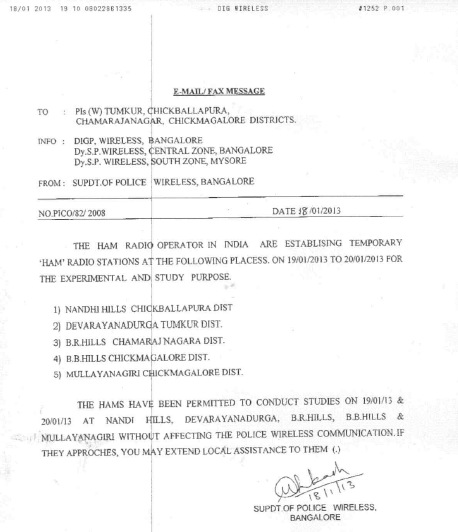
Following is the permissions from DIG Karnataka Police Wireless for this exercise.


View ARSI VHF Hilltop Contest 2013 in a larger map Checkout Ham concentration in South India! Hope to create big buzz this time... VU3KPL

Convenience or Compromise antenna for portable HF?!

 It depends on what one considers as good ops!. When speed matters like in regional emergency comms, NVIS strategy is most beneficial. NVIS ...