Checkout my 3830 article on some interesting observations during CQWPX SSB contest 2013
http://lists.contesting.com/archives//html/3830/2013-04/msg00163.html
Enjoy!
Kiran VU3KPL
Tuesday, April 2, 2013

Saturday, March 9, 2013
DXing from QTH near high tension voltage line
With TX5K gone QRT this morning, it was bit of disappointing for me. I was trying to follow them all over bands from 20m to 10m on SSB and CW but no sign for me other than noise.
Just when VU3DMP was working them on Long path (around 7:30AM IST i.e 2:00 UTC), i was having 54 noise and just nothing. Obviously VU3DMP, including 2PAI, 2NKS all live on coastal area with highly conductive ground and have atleast 3 element Yagi antennas. 2PTT lives in Bangalore though. It was puzzling for me when i saw their multi band QSOs. It was not just about patience, grey line timing or power output i thought!. It is also the place you live in I concluded.
My current QTH a rented apartment 5 floors above with dense surrounding population. There is high tension overhead line going from SW to SE of my apartment at 100 ft and a cell phone tower at 200 ft in the same direction. I was observing very quite conditions when turning my 2 element Hexx beam to the south and exactly to the north( instead of higher noise levels). I had worked only handful JA stations and even less VK/ZL and ZS. Most of the stations i worked in these directions were relatively short distance like HS0, YB etc. And almost all these stations are high power one. I am starting to conclude that these are normally resultant of high angle radiation and I never caught low angle from south west, south or south east on Long path propagation.
TX5K was coming strong on long path during morning grey line as reported by some. But for me there was a suction effect for signals coming from south. Experts and grand fathers in this area of electromagnetism can clarify this better, but i recollect a theory from my college days. I remember right-hand rule for electromagnetism which says, if current is traveling in a line in the direction of your thumb, the magnetic field direction would then be in the circular direction of following your other fingers. reference link
If i consider this principle, high tension lines are right in between low angle radiation waves from south and my antenna. This may be acting like a RF sponge limiting my ability to listen to those weak signals. By the way i have tried other techniques of small magnetic listening loops, noise cancelling devices and large delta loops for improving reception earlier. But now I am sure that all those helped in reducing some specific noise problems, but solution to this RF sponging is no other than QSYing the QTH only. Fortunately for me i am going to QSY to another location in next couple of months.
So definitely another operation from Clipperton may or may not happen in near future, my learning from this chase has made me more knowledgeable on my favorite subjects of DXing and Propagation.
The day i work < 100watter stations from NA or SA from Bangalore, I can assume either we are at the top of propagation or all my local QRM and sponging problems are gone - which is still a dream!
Kiran VU3KPL
Why TX5K was important for me? -
Yeah definitely it was one most sought after DX entity for hams. More importantly, it is almost an antipodal point for India with distance on Long being 4000KM larger than Short path. This location offers an interesting observational benefit when it comes to propagation. As noted VU QSOs took place during morning greyline long path over south pole. Indicating that RF waves traveled over darker edge of the planet earth for longer distance and with enough energy to reach other side!.
Just when VU3DMP was working them on Long path (around 7:30AM IST i.e 2:00 UTC), i was having 54 noise and just nothing. Obviously VU3DMP, including 2PAI, 2NKS all live on coastal area with highly conductive ground and have atleast 3 element Yagi antennas. 2PTT lives in Bangalore though. It was puzzling for me when i saw their multi band QSOs. It was not just about patience, grey line timing or power output i thought!. It is also the place you live in I concluded.
My current QTH a rented apartment 5 floors above with dense surrounding population. There is high tension overhead line going from SW to SE of my apartment at 100 ft and a cell phone tower at 200 ft in the same direction. I was observing very quite conditions when turning my 2 element Hexx beam to the south and exactly to the north( instead of higher noise levels). I had worked only handful JA stations and even less VK/ZL and ZS. Most of the stations i worked in these directions were relatively short distance like HS0, YB etc. And almost all these stations are high power one. I am starting to conclude that these are normally resultant of high angle radiation and I never caught low angle from south west, south or south east on Long path propagation.
TX5K was coming strong on long path during morning grey line as reported by some. But for me there was a suction effect for signals coming from south. Experts and grand fathers in this area of electromagnetism can clarify this better, but i recollect a theory from my college days. I remember right-hand rule for electromagnetism which says, if current is traveling in a line in the direction of your thumb, the magnetic field direction would then be in the circular direction of following your other fingers. reference link
If i consider this principle, high tension lines are right in between low angle radiation waves from south and my antenna. This may be acting like a RF sponge limiting my ability to listen to those weak signals. By the way i have tried other techniques of small magnetic listening loops, noise cancelling devices and large delta loops for improving reception earlier. But now I am sure that all those helped in reducing some specific noise problems, but solution to this RF sponging is no other than QSYing the QTH only. Fortunately for me i am going to QSY to another location in next couple of months.
So definitely another operation from Clipperton may or may not happen in near future, my learning from this chase has made me more knowledgeable on my favorite subjects of DXing and Propagation.
The day i work < 100watter stations from NA or SA from Bangalore, I can assume either we are at the top of propagation or all my local QRM and sponging problems are gone - which is still a dream!
Kiran VU3KPL
Why TX5K was important for me? -
Yeah definitely it was one most sought after DX entity for hams. More importantly, it is almost an antipodal point for India with distance on Long being 4000KM larger than Short path. This location offers an interesting observational benefit when it comes to propagation. As noted VU QSOs took place during morning greyline long path over south pole. Indicating that RF waves traveled over darker edge of the planet earth for longer distance and with enough energy to reach other side!.
Thursday, January 17, 2013
ARSI VHF HillTop Communication contest 2013 station locations
We will operate as VU2GRM from Devarayana Durga, Tumkur, Karnataka at height of around 4000ft ASL
Our objective of this exericse would be to study line of sight communication from various parts of India. This will help in future emergency preparedness for Hams.
Following is the permissions from DIG Karnataka Police Wireless for this exercise.
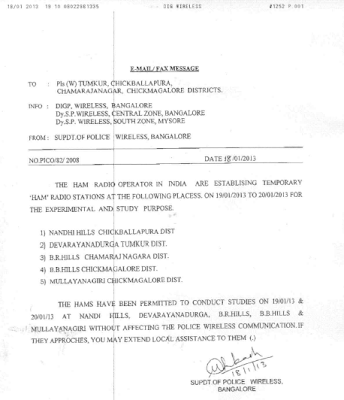
View ARSI VHF Hilltop Contest 2013 in a larger map Checkout Ham concentration in South India! Hope to create big buzz this time... VU3KPL
Our objective of this exericse would be to study line of sight communication from various parts of India. This will help in future emergency preparedness for Hams.
Following is the permissions from DIG Karnataka Police Wireless for this exercise.
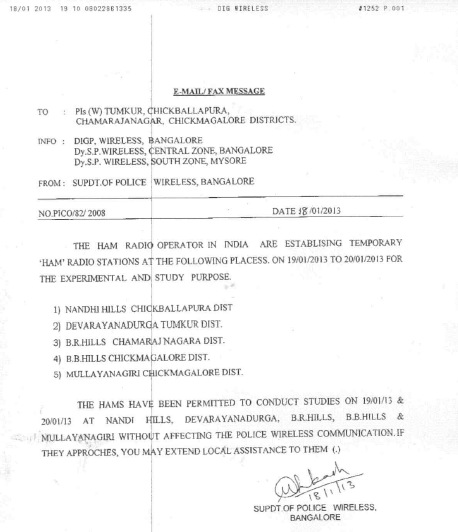
View ARSI VHF Hilltop Contest 2013 in a larger map Checkout Ham concentration in South India! Hope to create big buzz this time... VU3KPL
Tuesday, September 18, 2012
Diamond DXCC 2012
Just received DDXCC certificate confirming contacts with 100 DX entities from 1932 DXCC list.

What a joy chasing the rare ones with some historical significance that too with mere 50W from a urban jungle full of RFI! .
Setup:
5 band completely homebrewed Hexxabeam : This one is real winner which got my country total for 2012 to 130+.(from March to Sept). Looking for CQWW for sweeping some more DX from Africa and Caribbean.

Yaesu 857 trx with modified Creative headset and foot switch interface box.

See you on air
73s Kiran

What a joy chasing the rare ones with some historical significance that too with mere 50W from a urban jungle full of RFI! .
Setup:
5 band completely homebrewed Hexxabeam : This one is real winner which got my country total for 2012 to 130+.(from March to Sept). Looking for CQWW for sweeping some more DX from Africa and Caribbean.

Yaesu 857 trx with modified Creative headset and foot switch interface box.

See you on air
73s Kiran
Monday, June 18, 2012
Optimizing Amateur Radio's effecitve radiating power
I hold restricted grade Amateur Radio license with voice mode endorsement. It allows me to transmit only of 50W on HF. When I wanted to set my station at Bangalore, I wanted it to optimally use all the allowed power and get on the air. Referring to many internet information available on various subjects, i found that most of the hams(including me!) never optimize their station and take advantage of power. Although power shows up as 50W or 100W going out of their rig, how much is actually transmitted out their antenna in a desired direction is very important.
Lets look at some of the aspects which i considered (the way in which i understand them):
Antenna:
This metal structure everyone knows is very important for transmission/reception.There are couple of important aspects in the antennas 1. resonance at desired frequency 2. line impedance match 3. gain in desired direction
1. Resonance: when the RF wave finds matching length of conductor we call it as antenna is resonating at that frequency. Ideally only resonant frequency should be available to listen or transmit efficiently. However antenna tends to have behavior of acceptable bandwidths. That is the range of frequencies for which efficiency becomes acceptable. For small space antennas like magnetic loops, loaded antennas etc this range is very narrow. When length of conductor is longer(2-3 times) than wavelength of maximum desired frequency wavelength, it can resonate at various frequencies below it. So a tuner can make sure that conductor accepts or transmits desired frequency.
Tips:
Tips:
3. Gain in desired direction (DBd gain in decibels measured with a dipole reference point) Do we require to transmit in a direction which is not intended to be?. Like a 50 W light bub hanging over head without its reflector, antenna would have no focus. Put a reflector all light now with same 50W bulb seems to be with more brightness for the person infront of it. Put a lens in-front of the bulb, light rays gets sharper and intense in-front of it. Similarly in RF, using a single element vs using two or more element has its advantages. All this gain comes with its mechanical and spacial overheads too. Work on a space optimized and gain optimized antenna at a clear height of around 30ft from ground or above.Check nearby obstacles like highrise buildings, mountains etc. these will have adverse impact on signals in their direction.
Cable:
Chose best available cables for your needs. Onetime investment of few hundred Rupee more will take you through seven sees for years. Chose bare copper over tinned copper braids.
Typically Indian station antennas are just above the roof level and coax lengths are around 50ft.
Cable loss : refer to http://www.timesmicrowave.com/cgi-bin/calculate.pl

There are other cables which also can be used per availability and technical requirements.
Do not compromise on connector soldering joints. Poor joints yields in RF loss as well. If you are using antenna switches, make sure you maintain them for best contacts. Remove unwanted coax hops between trx and antenna like keeping a unwanted coax plug joint or a antenna switch which you rarely use etc.
Ground:
You may see lots of informative articles on arrl.org or elsewhere on grounding. A good ground for antenna tower reduces lightening risk. A good ground in your RF channel like TRX body and Cable jacket reduces return currents and RFI. A good ground for the DC/AC power reduces probability of electric shock.
Over all keep your system clean, even if you are running QRP levels, you will make most out of your available power.
All the best, hope to have a QSO with you soon
73
DE VU3KPL Kiran
Lets look at some of the aspects which i considered (the way in which i understand them):
Antenna:
This metal structure everyone knows is very important for transmission/reception.There are couple of important aspects in the antennas 1. resonance at desired frequency 2. line impedance match 3. gain in desired direction
1. Resonance: when the RF wave finds matching length of conductor we call it as antenna is resonating at that frequency. Ideally only resonant frequency should be available to listen or transmit efficiently. However antenna tends to have behavior of acceptable bandwidths. That is the range of frequencies for which efficiency becomes acceptable. For small space antennas like magnetic loops, loaded antennas etc this range is very narrow. When length of conductor is longer(2-3 times) than wavelength of maximum desired frequency wavelength, it can resonate at various frequencies below it. So a tuner can make sure that conductor accepts or transmits desired frequency.
Tips:
- Have your antenna elements cut as per designed frequencies
- Use high quality conductors (thicker diameter the better)
Tips:
- Reduce SWR with proper line balancers like BalUns
- Reduce surface currents using RF chokes
3. Gain in desired direction (DBd gain in decibels measured with a dipole reference point) Do we require to transmit in a direction which is not intended to be?. Like a 50 W light bub hanging over head without its reflector, antenna would have no focus. Put a reflector all light now with same 50W bulb seems to be with more brightness for the person infront of it. Put a lens in-front of the bulb, light rays gets sharper and intense in-front of it. Similarly in RF, using a single element vs using two or more element has its advantages. All this gain comes with its mechanical and spacial overheads too. Work on a space optimized and gain optimized antenna at a clear height of around 30ft from ground or above.Check nearby obstacles like highrise buildings, mountains etc. these will have adverse impact on signals in their direction.
Cable:
Chose best available cables for your needs. Onetime investment of few hundred Rupee more will take you through seven sees for years. Chose bare copper over tinned copper braids.
Typically Indian station antennas are just above the roof level and coax lengths are around 50ft.
Cable loss : refer to http://www.timesmicrowave.com/cgi-bin/calculate.pl

There are other cables which also can be used per availability and technical requirements.
Do not compromise on connector soldering joints. Poor joints yields in RF loss as well. If you are using antenna switches, make sure you maintain them for best contacts. Remove unwanted coax hops between trx and antenna like keeping a unwanted coax plug joint or a antenna switch which you rarely use etc.
Ground:
You may see lots of informative articles on arrl.org or elsewhere on grounding. A good ground for antenna tower reduces lightening risk. A good ground in your RF channel like TRX body and Cable jacket reduces return currents and RFI. A good ground for the DC/AC power reduces probability of electric shock.
Over all keep your system clean, even if you are running QRP levels, you will make most out of your available power.
All the best, hope to have a QSO with you soon
73
DE VU3KPL Kiran
Saturday, January 14, 2012
5 band Hexbeam Antenna homebrewing in Bangalore: Jan-Feb 2011
Hi all,
I am planning to homebrew Hexbeam with fiberglass spreaders and 1.5 sqmm insulated wires. I have already ordered 3 extra sets of fiberglass spreaders and wires for the project.
I am looking for fabricating base plates and buying hoseclamps, support cords etc as well. ( any knowhows on suppliers and fabricators would be helpful)
If any one is interested in homebrewing, please let me know. we can share the actual costs and build quality HF 5 bander.
Items to be collected in Bangalore only. Please leave a comment to this blog if interested.
DE VU3KPL
Kiran
Update: 18/Jun/2012
I am planning to homebrew Hexbeam with fiberglass spreaders and 1.5 sqmm insulated wires. I have already ordered 3 extra sets of fiberglass spreaders and wires for the project.
I am looking for fabricating base plates and buying hoseclamps, support cords etc as well. ( any knowhows on suppliers and fabricators would be helpful)
If any one is interested in homebrewing, please let me know. we can share the actual costs and build quality HF 5 bander.
Items to be collected in Bangalore only. Please leave a comment to this blog if interested.
DE VU3KPL
Kiran
Update: 18/Jun/2012
Already 102 DX entities worked on Hexx with just 50W SSB in just two
months (casual style DXing). My buddy VU3NXI and myself are very proud
of this homebrewed antenna.
Sunday, June 12, 2011
Ham Radio experiment with 20m hexbeam
It was long time since my on air activity from India and never before had a opportunity to operate from my permanent QTH (near Mangalore). After my last period of VU operation from Mumbai during 2000-2003/4, My station (VU3KPL) was down. I thought CQ WPX CW contesting weekend 28th and 29th may 2011 is right time to start the hobby again. Timing seemed perfect to try new things.
 Had studied about KIO and Traffie hexbeams. I had received 6 xenon fishing rods(fiberglass 3.9mtr long) from my brother's DX trip. Although rod walls seemed thinner, for my temporary setup it was ok.

Next problem was with hub design. Fortunately one of the local fabricator agreed to get it done same evening as i was planning. It took an hour to get the work using 1.5" (1.5' high) GI pipe as center mast and 1/2" GI pipes as support spokes.
Went to local hardware shop for PVC mast(piece above the GI hub), nylon ropes and S hooks. S hooks were unavailable, but genius workaround was suggested by my local friend. He gave a steel chain from which each link can be taken out in the form of S.
Measured length of fishing rod from its base to lure rod's string support rings. It was around 4" more than suggested 128" for spreader support. Cut seven 133" nylon cords and attached S clips at the end. Similarly cut driven and reflector wires, attached separators as nylon cords (2') again. Kept everything ready for next day's early morning assembly.
Early morning started spreading out telescopic rods and tied all cords to central PVC mast. This task was easy. Then laid wires around the structure. All well.
It was very hot and humid by 9AM here. Kept remaining task for the evening as signal would not appear during the day time.
Took a old 12', 3/4"water pipe as mast. Unfortunately when raising, it broke at couple of week points(because of its aging). One of the spreader arm also got fractured at support hub. Situation became tense as effort might have to be halted. Then with help of friends and family, got another GI pipe 15' (3/4") and raised antenna successfully. Raising this antenna is most difficult task.
Switched on my Yaeusu 857D, very good signal reception was heard with almost no ground noise. Then did a quick SWR check. It was around 1.5 for bothCW and SSB section of 20m. More height could have brought this SWR down. Made some quick contacts with DX stations J25, IZ, LA2 etc with 50 watts and got 56 to 59 report. What more to expect from an antenna only 15' high. Due absence of rotator, i could not check directivity. It was stationary looking north, north-west. So most of the contacts were from Europe, Mid East and couple from Africa. I also heard signals from US east coast (Florida). Overall structure was very stable and performance is well told with the log constituting 21 DXCC entries.
Here is a list of stations worked all with max power of 50W
date UTC TX kHz Mode Call RST S RST R
-------------------- -------- ---- ------ ----- -----
27-May-2011 14:23:05 14056.0 CW UA6AQB 569 599
27-May-2011 14:42:23 14.2 SSB IZ0RPZ 59 59
27-May-2011 14:59:02 14.2 SSB J25DXA 59 59
27-May-2011 15:12:40 14.2 SSB LA2PC 59 56
27-May-2011 15:19:59 14.3 SSB 9M4SJN 59 59
27-May-2011 15:32:14 14.2 SSB LZ3SD 56 57
27-May-2011 15:41:28 14.2 SSB OZ3FD 58 58
27-May-2011 15:45:55 14.3 SSB DM3MR 58 58
27-May-2011 17:06:30 14.2 SSB CT1EHI 59 56
28-May-2011 12:18:01 14.2 SSB XU7TZG 56 56
28-May-2011 12:21:34 14.2 SSB VU2AGJ 59 59
28-May-2011 12:23:30 14.2 SSB VU2DK 59 59
28-May-2011 12:28:13 14.2 SSB VU2PT 59 59
28-May-2011 14:44:35 14.2 SSB IZ2ACD 58 57
28-May-2011 14:55:01 14.3 SSB DH7LF 58 57
28-May-2011 15:02:33 14.2 SSB PB5X 59 55
28-May-2011 15:07:33 14.3 SSB IZ1PNT 58 55
29-May-2011 14:13:15 14.2 SSB ET3AA 58 59
29-May-2011 14:52:18 14.2 SSB A61ZX 59 59
29-May-2011 15:03:36 14.2 SSB HS0ZCW 59 57
29-May-2011 15:18:26 14.2 SSB IV3UTV 59 55
01-Jun-2011 11:30:13 14.2 SSB VU2AU 59 59
01-Jun-2011 11:38:42 14.2 SSB A41NN 59 55
01-Jun-2011 12:29:09 14.2 SSB VU3RID 56 59
01-Jun-2011 13:23:46 14.2 SSB VU2AGJ 59 59
01-Jun-2011 13:25:47 14.2 SSB VU2DSI 59 59
01-Jun-2011 16:48:55 14.2 SSB 5Z4ES 59 55
02-Jun-2011 12:16:22 14.2 SSB VU2YK 59 59
02-Jun-2011 12:19:50 14.2 SSB VU2OO 59 59
02-Jun-2011 12:33:56 14.2 SSB VU2AGJ 59 59
02-Jun-2011 12:50:14 14.2 SSB A41LD 59 59
02-Jun-2011 13:00:24 14.2 SSB VU3MRT 45 59
02-Jun-2011 17:45:44 14.1 CW IT9KYF 599 559
03-Jun-2011 16:44:39 14.2 SSB F8DVD 59 52
03-Jun-2011 17:22:50 14.2 SSB IK2IQD 59 59
04-Jun-2011 02:48:35 14.2 SSB 4K6FO 58 59
04-Jun-2011 13:28:08 14.2 SSB VU2DK 59 59
04-Jun-2011 13:57:36 14.2 SSB VU2ASH 58 56
04-Jun-2011 15:39:04 14.2 SSB VU2CDW 59 59
05-Jun-2011 05:32:03 14.2 SSB ER4DX 59 57
73
VU3KPL
Update: 18/Jun/2012:
Subsequently in first quarter of 2012 I gathered few friends in Bangalore to work on 5Band version of this antenna with better quality support structures.
I love this hobby!
Kiran
 Had studied about KIO and Traffie hexbeams. I had received 6 xenon fishing rods(fiberglass 3.9mtr long) from my brother's DX trip. Although rod walls seemed thinner, for my temporary setup it was ok.
Next problem was with hub design. Fortunately one of the local fabricator agreed to get it done same evening as i was planning. It took an hour to get the work using 1.5" (1.5' high) GI pipe as center mast and 1/2" GI pipes as support spokes.
Went to local hardware shop for PVC mast(piece above the GI hub), nylon ropes and S hooks. S hooks were unavailable, but genius workaround was suggested by my local friend. He gave a steel chain from which each link can be taken out in the form of S.
Measured length of fishing rod from its base to lure rod's string support rings. It was around 4" more than suggested 128" for spreader support. Cut seven 133" nylon cords and attached S clips at the end. Similarly cut driven and reflector wires, attached separators as nylon cords (2') again. Kept everything ready for next day's early morning assembly.
Early morning started spreading out telescopic rods and tied all cords to central PVC mast. This task was easy. Then laid wires around the structure. All well.
It was very hot and humid by 9AM here. Kept remaining task for the evening as signal would not appear during the day time.
Took a old 12', 3/4"water pipe as mast. Unfortunately when raising, it broke at couple of week points(because of its aging). One of the spreader arm also got fractured at support hub. Situation became tense as effort might have to be halted. Then with help of friends and family, got another GI pipe 15' (3/4") and raised antenna successfully. Raising this antenna is most difficult task.
Switched on my Yaeusu 857D, very good signal reception was heard with almost no ground noise. Then did a quick SWR check. It was around 1.5 for bothCW and SSB section of 20m. More height could have brought this SWR down. Made some quick contacts with DX stations J25, IZ, LA2 etc with 50 watts and got 56 to 59 report. What more to expect from an antenna only 15' high. Due absence of rotator, i could not check directivity. It was stationary looking north, north-west. So most of the contacts were from Europe, Mid East and couple from Africa. I also heard signals from US east coast (Florida). Overall structure was very stable and performance is well told with the log constituting 21 DXCC entries.
Here is a list of stations worked all with max power of 50W
date UTC TX kHz Mode Call RST S RST R
-------------------- -------- ---- ------ ----- -----
27-May-2011 14:23:05 14056.0 CW UA6AQB 569 599
27-May-2011 14:42:23 14.2 SSB IZ0RPZ 59 59
27-May-2011 14:59:02 14.2 SSB J25DXA 59 59
27-May-2011 15:12:40 14.2 SSB LA2PC 59 56
27-May-2011 15:19:59 14.3 SSB 9M4SJN 59 59
27-May-2011 15:32:14 14.2 SSB LZ3SD 56 57
27-May-2011 15:41:28 14.2 SSB OZ3FD 58 58
27-May-2011 15:45:55 14.3 SSB DM3MR 58 58
27-May-2011 17:06:30 14.2 SSB CT1EHI 59 56
28-May-2011 12:18:01 14.2 SSB XU7TZG 56 56
28-May-2011 12:21:34 14.2 SSB VU2AGJ 59 59
28-May-2011 12:23:30 14.2 SSB VU2DK 59 59
28-May-2011 12:28:13 14.2 SSB VU2PT 59 59
28-May-2011 14:44:35 14.2 SSB IZ2ACD 58 57
28-May-2011 14:55:01 14.3 SSB DH7LF 58 57
28-May-2011 15:02:33 14.2 SSB PB5X 59 55
28-May-2011 15:07:33 14.3 SSB IZ1PNT 58 55
29-May-2011 14:13:15 14.2 SSB ET3AA 58 59
29-May-2011 14:52:18 14.2 SSB A61ZX 59 59
29-May-2011 15:03:36 14.2 SSB HS0ZCW 59 57
29-May-2011 15:18:26 14.2 SSB IV3UTV 59 55
01-Jun-2011 11:30:13 14.2 SSB VU2AU 59 59
01-Jun-2011 11:38:42 14.2 SSB A41NN 59 55
01-Jun-2011 12:29:09 14.2 SSB VU3RID 56 59
01-Jun-2011 13:23:46 14.2 SSB VU2AGJ 59 59
01-Jun-2011 13:25:47 14.2 SSB VU2DSI 59 59
01-Jun-2011 16:48:55 14.2 SSB 5Z4ES 59 55
02-Jun-2011 12:16:22 14.2 SSB VU2YK 59 59
02-Jun-2011 12:19:50 14.2 SSB VU2OO 59 59
02-Jun-2011 12:33:56 14.2 SSB VU2AGJ 59 59
02-Jun-2011 12:50:14 14.2 SSB A41LD 59 59
02-Jun-2011 13:00:24 14.2 SSB VU3MRT 45 59
02-Jun-2011 17:45:44 14.1 CW IT9KYF 599 559
03-Jun-2011 16:44:39 14.2 SSB F8DVD 59 52
03-Jun-2011 17:22:50 14.2 SSB IK2IQD 59 59
04-Jun-2011 02:48:35 14.2 SSB 4K6FO 58 59
04-Jun-2011 13:28:08 14.2 SSB VU2DK 59 59
04-Jun-2011 13:57:36 14.2 SSB VU2ASH 58 56
04-Jun-2011 15:39:04 14.2 SSB VU2CDW 59 59
05-Jun-2011 05:32:03 14.2 SSB ER4DX 59 57
73
VU3KPL
Update: 18/Jun/2012:
Subsequently in first quarter of 2012 I gathered few friends in Bangalore to work on 5Band version of this antenna with better quality support structures.
I love this hobby!
Kiran
Subscribe to:
Posts (Atom)
Convenience or Compromise antenna for portable HF?!
It depends on what one considers as good ops!. When speed matters like in regional emergency comms, NVIS strategy is most beneficial. NVIS ...

-
 It is that time of the year when Hams around the globe warmup and charge ionosphere to create th eir own Propagation Conditions. And this...
 -
 Not all hams have similar aspirations of field days. Some go to outdoors for pure fun and relaxation, some to enjoy nature, some to learn ab...
 -
Hi all, I am planning to homebrew Hexbeam with fiberglass spreaders and 1.5 sqmm insulated wires. I have already ordered 3 extra sets of fi...